
Veterans Can Apply for Free Window Replacement Programs are not typically standalone “free window grants” offered directly by the federal government in 2026. Instead, veterans may be able to access existing home repair, energy-efficiency, and disability-related assistance programs that can help cover window replacements or subsidize costs.
These programs are often related to broader home improvement or weatherization initiatives and may be administered by the Department of Veterans Affairs (VA), U.S. Department of Energy (DOE), or state and local agencies.
In this article, we’ll explore the key programs and resources that veterans might use to obtain window replacement support, including government-funded weatherization assistance, disability housing grants, nonprofit partnerships, and eligibility criteria available in 2026.
You’ll learn how each works, who qualifies, how to apply, what documentation you’ll need, and whether all types of windows and installations are covered. This guide gives practical, up-to-date information rooted in current federal and nonprofit initiatives that can benefit veterans.
By the end of this article, you’ll have a clear roadmap for pursuing window replacement help as a veteran in 2026. Whether you’re seeking energy-efficient upgrades, accessibility-related modifications, or low-income assistance, you’ll know which programs might apply and how to get started. Let’s break down the opportunities and steps ahead.
Also, Read | What Happens to the Debt When a Car is Repossessed
What Government Programs Offer Free Window Replacement for Veterans in 2026?
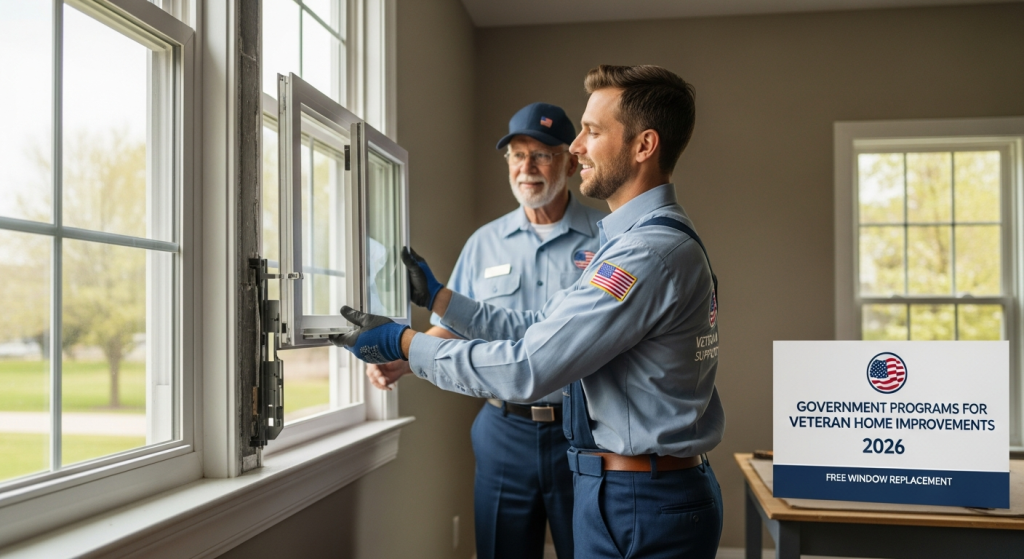
In 2026, there aren’t dedicated federal “free window replacement” programs for veterans the way some people might expect. However, several government initiatives and grant programs can help veterans get window replacements or energy-efficient upgrades as part of broader home improvement or adaptation assistance.
These options often focus on energy efficiency, accessibility, or low-income housing support rather than window replacements alone.
Many of these government supports are available nationwide through agencies like the Department of Veterans Affairs (VA) or the Department of Energy (DOE), and eligibility typically depends on income, disability status, or home condition.
They aren’t labelled strictly “veteran window programs,” but they do include window work within their eligible services.
Examples of programs that may cover window replacement (fully or partially):
Weatherization Assistance Program (WAP): Federal energy-efficiency program that can include window replacement or repair for low-income homes.
VA Home Improvement and Structural Alterations (HISA) Grant: Helps veterans with service-connected disabilities make home modifications, potentially including new windows in certain cases.
VA Specially Adapted Housing (SAH) and Special Home Adaptation (SHA) Grants: Large housing adaptation grants that may be used toward window modifications as part of broader accessibility projects.
Low Income Home Energy Assistance Program (LIHEAP): Helps low-income households with energy costs and can include weatherization upgrades like window sealing or replacement.
Even though no program is labelled strictly “free window replacement for veterans,” these existing government supports offer pathways for veterans to secure window work as part of broader home assistance.
Scrolling down the list to find the best fit usually depends on your homeownership status, income level, disability rating, and location.
Local state or county energy offices frequently administer the federal programs, so contacting them can point you to available window-related services for veterans.
Also, Read | How to Cash Out Bitcoin on Cash App
Who is Eligible to Apply for Veteran-Focused Window Replacement Programs this Year?
Eligibility for veteran window replacement support in 2026 usually depends on participation in broader home repair, energy efficiency, or disability adaptation programs rather than a dedicated “veteran window replacement” grant.
Most government programs that can include window work use criteria like income level, disability status, homeownership, or energy burden rather than veteran status alone.
For veterans, specific programs like the VA’s disability housing assistance grants also apply strict requirements tied to medical need and service connection. Veterans without those qualifying factors may need to rely on low-income or weatherization waiting lists. Here’s what generally matters across these programs in 2026:
Common eligibility points:
Income levels: Many energy-assistance and weatherization programs, such as WAP or LIHEAP, prioritize households at or below 200% of the Federal Poverty Level or similar income limits.
Veteran status: While veteran status alone doesn’t guarantee eligibility, being a veteran may help when combined with income or disability criteria.
Homeownership or occupancy: Most programs require the applicant to own or occupy the home as a primary residence.
Disability or special needs: VA grants such as HISA, SAH, or SHA require a service-connected disability or medically necessary modifications for eligibility.
Energy burden or priority groups: Low-income families, seniors, and those with high energy costs often receive priority for weatherization services, which might include window work.
Meeting these criteria doesn’t automatically guarantee support in many cases; applicants are placed on waitlists or must document income and home condition. Veterans with documented disabilities may have more tailored support available, especially for medically necessary modifications.
Even if veteran status alone doesn’t qualify you, combining it with income limits, energy burden, or documented disability can open doors to programs that do assist with window replacement or related home upgrades.
Also, Read | Can You Pay Your Mortgage with a Credit Card
Who is Eligible to Apply for Veteran-focused Window Replacement Assistance this Year?
Eligibility for veteran window replacement support in 2026 usually depends on participation in broader home repair, energy efficiency, or disability adaptation programs rather than a dedicated “veteran window replacement” grant. Most government programs that can include window work use criteria like income level, disability status, homeownership, or energy burden rather than veteran status alone.
For veterans, specific programs like the VA’s disability housing assistance grants also apply strict requirements tied to medical need and service connection. Veterans without those qualifying factors may need to rely on low-income or weatherization waiting lists. Here’s what generally matters across these programs in 2026:
Common eligibility points:
Income levels: Many energy-assistance and weatherization programs, such as WAP or LIHEAP, prioritize households at or below 200% of the Federal Poverty Level or similar income limits.
Veteran status: While veteran status alone doesn’t guarantee eligibility, being a veteran may help when combined with income or disability criteria.
Homeownership or occupancy: Most programs require the applicant to own or occupy the home as a primary residence.
Disability or special needs: VA grants such as HISA, SAH, or SHA require a service-connected disability or medically necessary modifications for eligibility.
Energy burden or priority groups: Low-income families, seniors, and those with high energy costs often receive priority for weatherization services, which might include window work.
Meeting these criteria doesn’t automatically guarantee support in many cases; applicants are placed on waitlists or must document income and home condition. Veterans with documented disabilities may have more tailored support available, especially for medically necessary modifications.
Even if veteran status alone doesn’t qualify you, combining it with income limits, energy burden, or documented disability can open doors to programs that do assist with window replacement or related home upgrades.
Also, Read | Using a HELOC for Debt Consolidation: A Smart Move?
Are there Nonprofit Organizations or Charities that Help Veterans with Home Window Upgrades?
Yes — while dedicated “free window replacement” charities specifically for veterans are rare, several nonprofit and charitable organizations offer home repair and modification support that can include window upgrades when part of larger improvements in 2026.
These organizations focus on helping veterans maintain safe, accessible, and energy-efficient homes, and window work often falls within the scope of their services when it improves comfort or safety.
Such groups usually require proof of service and financial need, and many operate locally through community affiliates or volunteer networks. They fill gaps left by government programs by providing hands-on projects or funding for essential home upgrades.
Nonprofits and charities helping veterans with home window upgrades:
Habitat for Humanity Veterans Build & Repair Corps: Offers critical home repairs, which can include window replacements or upgrades to improve safety and energy efficiency.
Rebuilding Together – Veterans at Home: Provides no-cost home modifications and repairs to improve safety and accessibility, often including drafty or inefficient windows.
Operation Homefront: Through its Critical Financial Assistance and housing programs, supports emergency home repairs or replacements that may cover windows for qualifying veterans.
Local nonprofit home repair groups (e.g., House of Heroes chapters): Volunteer-led organizations assist veterans and surviving spouses with accessibility and safety work, sometimes including window sill or frame repairs.
Patriot Services and similar regional efforts: Small nonprofit initiatives provide critical home repair support to veterans, including essential renovations that can involve windows.
These organizations often partner with corporate sponsors or community volunteers to deliver tangible improvements to veterans’ homes. They may host application periods, nomination processes, or community project days, and eligibility can vary by region and funding availability.
While not all of these groups guarantee window replacement on every project, their mission to help veterans maintain safe and healthy homes means window work is frequently included when it improves energy efficiency, accessibility, or structural safety.
Before applying, contact the local affiliate or chapter to verify whether window upgrades are supported and learn how to submit a request or nomination.
What Documents are Needed to Apply for No-cost Window Replacement as a Veteran?
When applying for no-cost or subsidized window replacement help in 2026, you’ll need to gather several key documents to prove eligibility, homeownership, income, and the need for the work. These documents vary by program; for example, energy efficiency/weatherization programs have different requirements than VA home improvement grants, but most require the same basic set of paperwork. It’s important to organize these early, as missing paperwork is a top reason applications get delayed or denied.
Whether you’re applying through a Weatherization Assistance Program (WAP), a VA HISA/Special Adapted Housing grant, or local nonprofit support, the following documentation helps verify your identity, financial status, residence, and why the work is necessary.
These documents form the backbone of your application and are often mandated by the program administrators to consider your request.
Common documents needed:
Proof of identity and service: Government-issued photo ID, Social Security number(s), and your DD-214 or veteran service records to verify military status.
Proof of income: Recent pay stubs, tax returns, Social Security benefit letters, or other income documentation to demonstrate eligibility, especially for income-based programs like WAP.
Proof of homeownership/occupancy: Mortgage statements, property deed/title, or property tax bills showing you own or reside in the home.
Utility bills: Recent gas, electric, or water bills help programs assess energy burden and justify energy-efficiency upgrades like new windows.
Insurance information: Proof of homeowner’s or renter’s insurance if required by the program.
Documentation of need: For some grants or energy-efficiency programs, photos of current window conditions, energy audit reports, or contractor estimates may be requested.
Most programs also have their own application forms that must be filled out and submitted along with these supporting documents. For example, local WAP providers often ask for a signed program application and proof of income, while VA-linked grants may require VA-specific forms obtainable through the VA’s eBenefits portal or regional office.
Keep digital copies and organized folders of each document, as programs frequently request them during the initial application and follow-up review stages. Being thorough from the start can speed up processing and avoid back-and-forth requests for missing information.
Do Free Window Replacement Programs for Veterans Cover all Window Types and Installation Costs?

In 2026, programs that help veterans with window replacement generally do not cover every window type or all installation costs. Coverage is usually limited to what’s considered necessary, cost-effective, and program-approved.
Most government and nonprofit programs focus on safety, accessibility, or energy efficiency rather than cosmetic or luxury upgrades. That means basic, functional window replacements are prioritized over high-end options.
The exact level of coverage depends on the program you qualify for, your home’s condition, and the results of any required inspection or energy audit. Some programs may fully cover materials and labour, while others only pay for specific window types or cap the total cost, leaving homeowners responsible for upgrades beyond the approved scope.
What is typically covered (and not covered):
Standard energy-efficient windows: Programs like the Weatherization Assistance Program usually approve double-pane, energy-efficient windows that meet federal efficiency standards, not custom or decorative designs. These are chosen to reduce drafts and heating or cooling costs rather than for appearance.
Installation labour: When window replacement is approved, basic installation costs are often included, but only through program-approved contractors. Homeowners usually cannot choose premium installers or request non-essential add-ons.
Repair vs. replacement decisions: Some programs may choose window repair, sealing, or weather-stripping instead of full replacement if it’s more cost-effective, even when windows are old.
Accessibility-related windows: VA disability grants may cover window modifications if they are part of a larger accessibility project, such as improving emergency egress or accommodating mobility needs.
Excluded upgrades: Speciality windows, oversized designs, aesthetic upgrades, or brand-specific preferences are commonly excluded and must be paid out of pocket if requested.
Because funding is limited, administrators focus on minimum standards and maximum impact. That’s why replacements are usually functional rather than customizable, and coverage is tied directly to program goals like energy savings or medical necessity.
Before approving any work, most programs require an inspection or audit to determine which windows qualify and how much funding can be applied. Understanding these limits ahead of time helps veterans avoid surprises and plan for any costs that may not be covered.
Are There Specific Programs Available for Disabled or Low-Income Veterans Seeking Window Replacement Help in 2026?
Yes, in 2026, there are specific programs designed to support disabled and low-income veterans that can include window replacement as part of broader home improvement or adaptation assistance.
These programs do not usually focus on windows alone, but they recognize that damaged, inefficient, or unsafe windows can directly affect health, accessibility, and energy costs. As a result, window upgrades may be approved when they align with program goals.
Disabled veterans often have access to more targeted housing assistance through the Department of Veterans Affairs, while low-income veterans may qualify through federal or state energy-efficiency and housing repair programs.
Each pathway has different rules, funding limits, and application steps, making it important to apply to the program that best matches your situation.
Programs that commonly help disabled or low-income veterans:
VA Home Improvement and Structural Alterations (HISA) Grant: Designed for veterans with service-connected or non-service-connected disabilities, this grant can cover medically necessary home modifications, including window changes when tied to safety or accessibility needs.
Specially Adapted Housing (SAH) Grant: For severely disabled veterans, SAH provides substantial funding for major home adaptations. Window modifications may be included as part of a larger renovation plan.
Special Home Adaptation (SHA) Grant: This program supports veterans with specific disabilities and may allow window replacements if they improve safety, ventilation, or emergency access.
Weatherization Assistance Program (WAP): Low-income veterans may qualify based on household income, with window replacement or repair included to improve energy efficiency and reduce utility costs.
State and local housing repair grants: Many states operate veteran-priority or low-income housing repair programs that can include window upgrades depending on funding availability.
For disabled veterans, documentation showing medical necessity is often the deciding factor. For low-income veterans, income thresholds and home condition assessments carry the most weight. In both cases, approval depends on inspections and available funding.
Applying to multiple eligible programs can increase your chances of receiving help, especially since some grants can be combined with nonprofit assistance to fully cover window replacement costs.
Conclusion
In 2026, veterans who need window replacements won’t usually find a single nationwide program offering free windows outright.
Instead, help comes through government energy-efficiency programs, VA housing grants, and nonprofit home repair organizations that include window replacement as part of broader assistance.
Understanding how these programs work and where windows fit into their scope is essential for setting realistic expectations.
Veterans who are low-income, disabled, or facing high energy costs tend to have the strongest eligibility. Preparing documents early, contacting local providers, and applying through multiple channels can significantly improve outcomes.
While the process may take time, these programs can reduce or eliminate window replacement costs and improve home safety, comfort, and efficiency.
FAQs
Veterans often have common questions about window replacement assistance. Here are answers to some frequently searched questions.
Can veterans really get free window replacement in 2026?
Not directly in most cases. Veterans may receive free or low-cost window replacements through weatherization, VA disability grants, or nonprofit home repair programs when windows are part of approved improvements.
Does the VA pay for new windows for veterans?
The VA may cover window-related work through programs like HISA, SAH, or SHA, but only when windows are part of medically necessary or accessibility-related home modifications.
Do low-income veterans qualify for window replacement help?
Yes. Low-income veterans may qualify through the Weatherization Assistance Program or state housing repair programs, where window replacement or repair is included to improve energy efficiency.
Are renters eligible for veteran window replacement programs?
Some programs allow renters to qualify, but landlord permission is usually required. Homeowners generally have more options and fewer restrictions.
How long does it take to get approved for window replacement assistance?
Approval timelines vary. Weatherization and nonprofit programs may take several months due to inspections and waitlists, while VA grants can take longer depending on documentation and review time.